Commercial Stainless Steel Sink Buying Guide
Single, double or pot wash — and which side the drainer goes. How to pick a commercial sink that fits your run and your wash-up.
Not sure which suits you? Call us on 03 9783 6325.
Compare the size, capacity and configuration that fit your space.
Use Borrelli product data rather than generic buying advice.
Ask our local team to check your choice before buying.
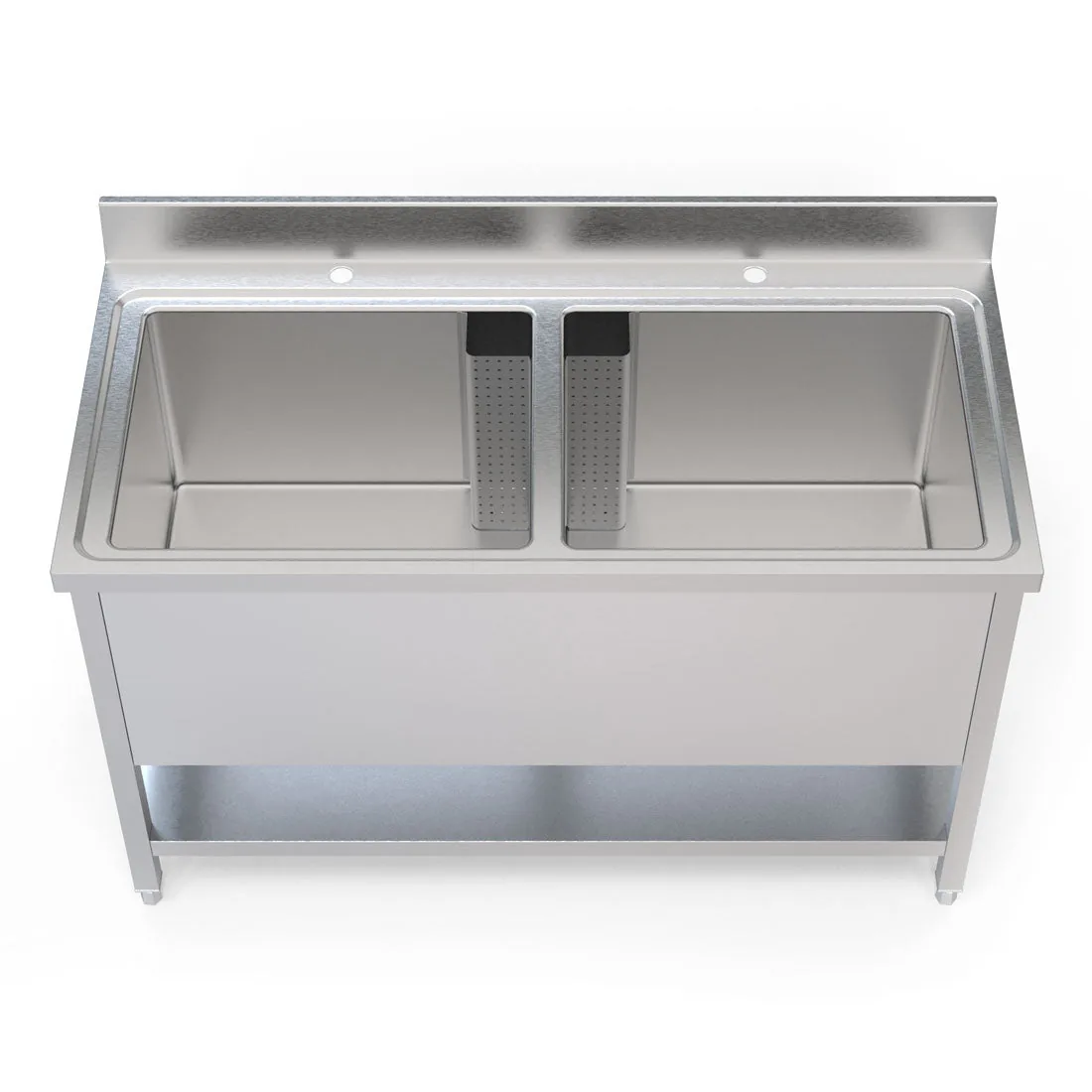
A commercial sink is the one fixture in a kitchen that every health inspection, every service and every close-down runs through. Get the size or the drainer side wrong and you don’t just have an awkward sink — you have staff carrying dripping trays across a bowl a hundred times a shift, or a unit that won’t fit the run you built the kitchen around.
Not every buyer runs a kitchen, either. A commercial-grade stainless sink is a popular choice for a laundry, a garage or workshop wash-up, an outdoor or alfresco kitchen, or a shed — it’s tougher and more hygienic than a domestic unit and takes the abuse. The decisions below are the same whether it’s going in a restaurant or your garage.
This guide covers what actually matters: how many bowls, which side the drainer goes, whether you need a pot wash, and what has to be true for it to fit and connect. Every figure is from our own range.
Single bowl, double bowl or pot wash? Start with the task
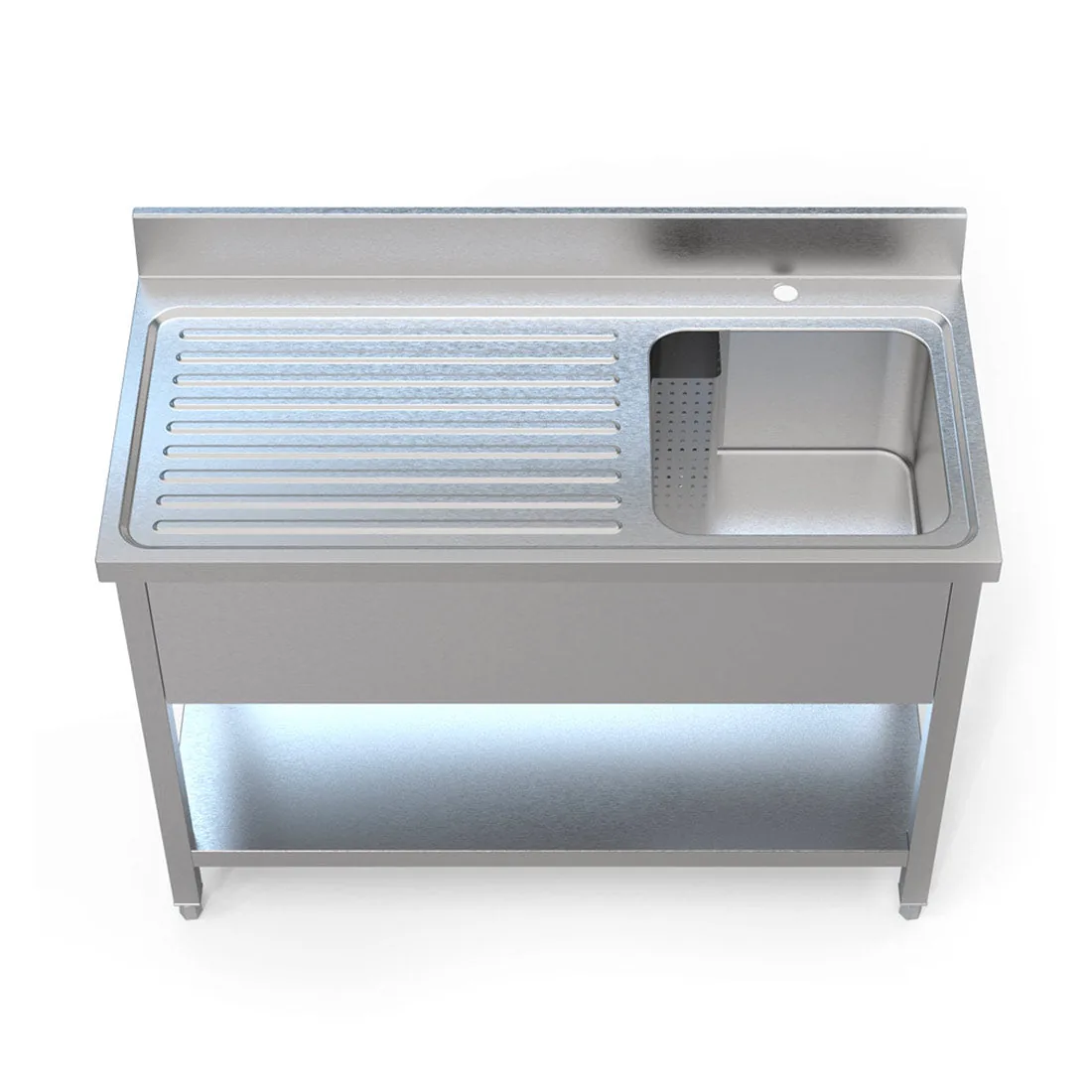
- Single bowl — general washing, prep rinsing, a hand-wash-up station. The right choice where space is tight or the sink isn’t the main dishwashing point. 1000mm and 1200mm wide.
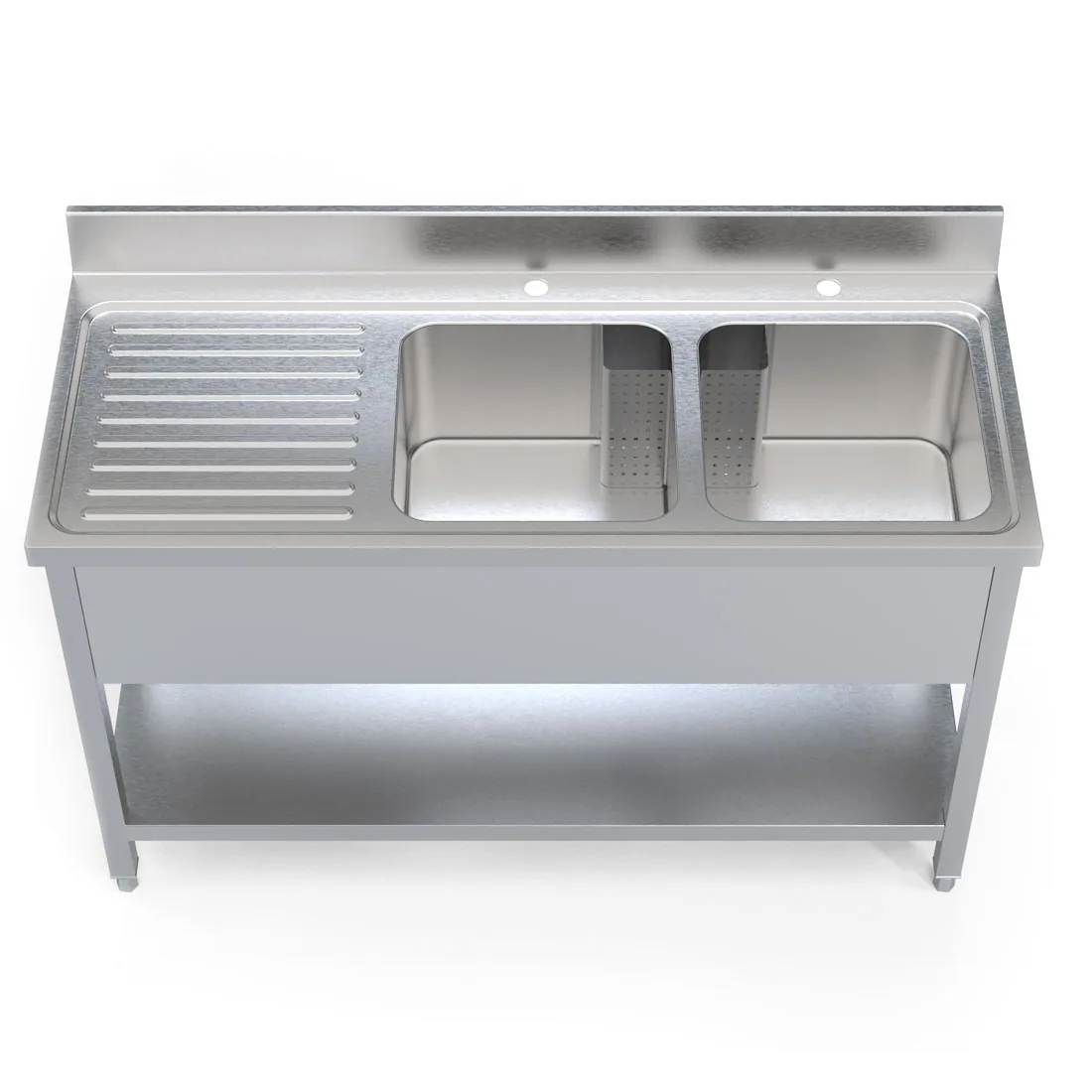
- Double bowl — the workhorse. Two bowls let you wash in one and rinse in the other, which is how most councils expect a manual wash-up to work. If this is your primary wash-up sink, start here. 1400mm to 1800mm wide.
- Pot wash — a single extra-large, extra-deep bowl built to swallow oven trays, gastronorm pans and stock pots that won’t fit a standard 400mm bowl. If your pain is scrubbing big cookware, this is the one. 600mm to 1400mm wide.
A common setup in a busy kitchen is a double bowl for everyday wash-up plus a pot wash for the big gear — they do different jobs and one doesn’t replace the other.
The range — models and sizes
All heights are 860mm to the bench (960mm to the top of the rear splashback), which lines up with a standard commercial prep bench so the sink sits flush in a run. Depth is 600mm on most models (700mm on the wider pot wash units). Tap any model to see live pricing and stock.
Single bowl
| Model | Width | Bowl (W × D × deep) |
|---|---|---|
| SSS-SB-LHD-1000Left drainer | 1000mm | 400 × 400 × 250mm |
| SSS-SB-RHD-1000Right drainer | 1000mm | 400 × 400 × 250mm |
| SSS-SB-LHD-1200Left drainer | 1200mm | 400 × 400 × 250mm |
| SSS-SB-RHD-1200Right drainer | 1200mm | 400 × 400 × 250mm |
Double bowl
| Model | Width | Bowls |
|---|---|---|
| SSS-TB-LHD-1400Left drainer | 1400mm | 2 × 400 × 400 × 250mm |
| SSS-TB-RHD-1400Right drainer | 1400mm | 2 × 400 × 400 × 250mm |
| SSS-TB-LHD-1600Left drainer | 1600mm | 2 × 400 × 400 × 250mm |
| SSS-TB-RHD-1600Right drainer | 1600mm | 2 × 400 × 400 × 250mm |
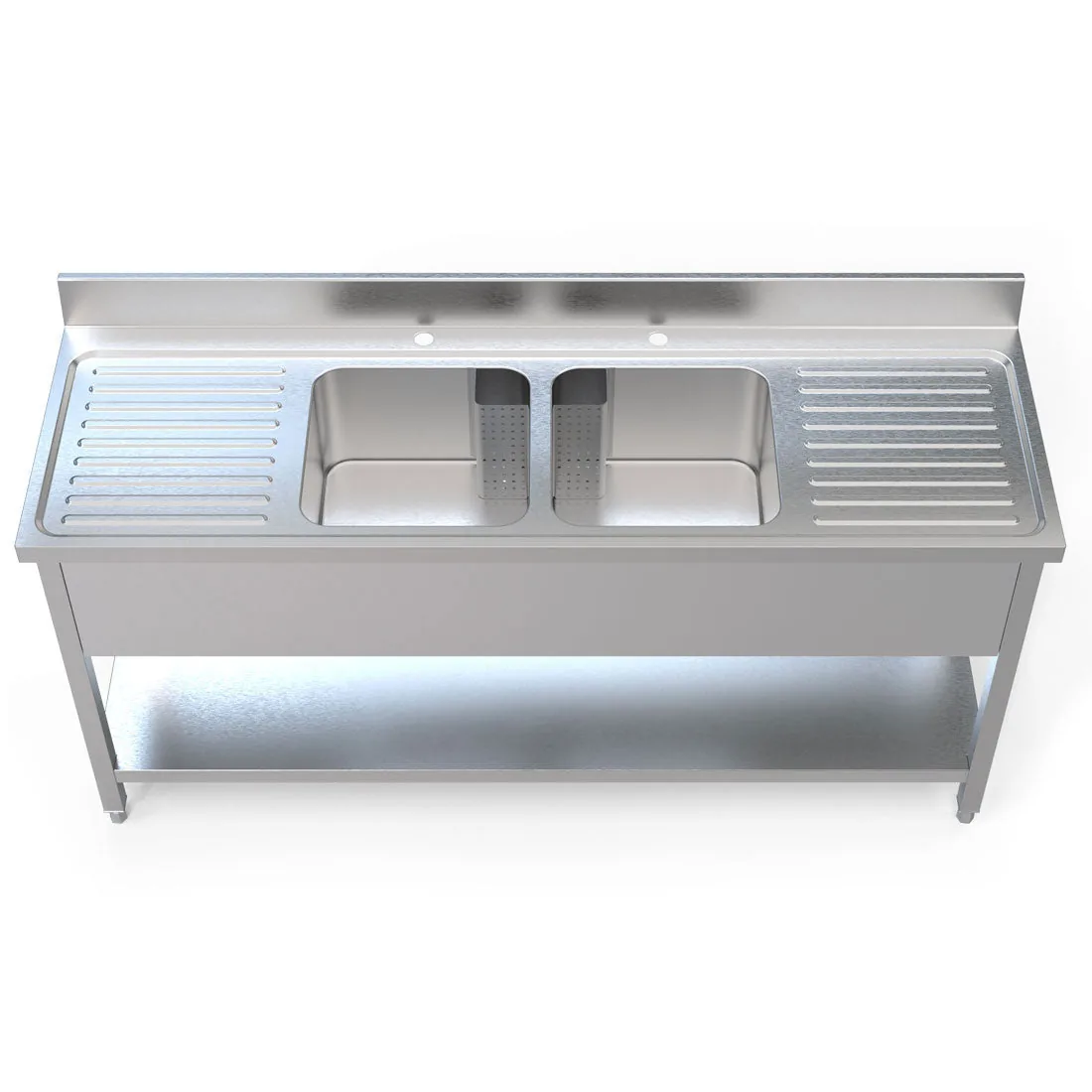
| SSS-TB-1800Drainer both sides | 1800mm | 2 × 400 × 400 × 250mm |
Pot wash
| Model | Width | Bowl |
|---|---|---|
| PWS-SB-600Single bowl | 600mm | Extra-large, 600mm deep |
| PWS-SB-800Single bowl | 800mm | Extra-large, 700mm deep |
| PW-1200-CB-1Single bowl | 1200mm | 1000mm-long bowl, 600mm deep |
| PWS-TB-1400Twin bowl | 1400mm | Twin large, 700mm deep |
Live pricing is on each product page — tap a model above for the current listing.
Left-hand or right-hand drainer? The one people get wrong
This is the decision that causes the most regret, and it’s simple once you see it.
Stand facing the sink. A left-hand drainer has the flat draining board on your left and the bowl on your right; a right-hand drainer is the mirror image. That’s all the name means — which side the drainer sits when you’re standing at it.
Choose it by the direction your wash-up flows. Dirty items come in on one side, get washed in the bowl, and clean items land on the drainer to drip and stack before they move on to a bench, a shelf or a dishwasher. You want the drainer on the side where clean items go next. If your clean bench or your dishwasher entry is to the right of the sink, buy a right-hand drainer, so washed items move naturally rightward instead of being carried back across a full bowl.
Get it backwards and every clean tray drips over the dirty bowl or gets double-handled. It’s a small decision that a busy kitchen feels on every shift.
If your sink sits in the middle of a run with benches both sides, or you just want flexibility, the 1800mm double-bowl (SSS-TB-1800) has a drainer on both sides and sidesteps the choice entirely.
Bowl size — will your gear actually fit?
The number nobody publishes and everybody needs. Standard bowls across the single and double range are 400 × 400mm and 250mm deep. That comfortably takes dinner plates, mixing bowls and 1/1 gastronorm pans on the flat, but a full-size oven tray or a tall stock pot is a squeeze.
That’s exactly what the pot wash range is for. Its bowls are extra-large — up to a 1000mm-long single bowl on the 1200mm unit — and the 800mm and 1400mm models go 700mm deep front to back, so a sheet tray or a 71L stockpot drops straight in. If big cookware is your daily grind, the size difference is the whole reason the pot wash exists.
All models use a standard 40mm waste outlet, so they connect to normal commercial plumbing without adapters.
Fit and installation
- Height: 860mm to the bench top, 960mm to the top of the rear splashback. Standard bench height, so it lines up with your stainless steel prep benches in a run.
- Depth: 600mm on most models; 700mm on the wider pot wash units — check the gap before you commit, especially against a wall with services behind.
- Rear splashback: raises the back to 960mm and protects the wall behind from splash.
- Undershelf: every model includes one — usable storage for tubs, chemicals or drying racks.
- Adjustable feet to level on an uneven floor.
- You’ll need a plumber. These are free-standing sinks that connect to your waste and water — the 40mm outlet is standard, but connection is a licensed-plumber job. Factor it into the fit-out cost.
What to look for in a commercial sink
- Commercial-grade stainless steel — hygienic, corrosion-resistant, wipes clean, and it’s what a health inspector expects to see.
- A rear splashback — protects the wall and keeps the join sealed and cleanable.
- A proper undershelf — turns the space under the bowl into storage instead of dead space.
- The right waste and overflow — a 40mm outlet that connects to standard plumbing.
- Adjustable feet — a level sink drains properly and doesn’t pool.
Warranty
Every Borrelli sink is backed by warranty — see the product page for the current term and what it covers. (We keep warranty details on the product page so there’s a single source of truth if terms change.)