


















Commercial Deep Fryer Buying Guide
Commercial Deep Fryer Buying Guide
Gas, electric or induction, counter or floor — how to choose a commercial deep fryer that keeps up.
Not sure which suits you? Call us on 03 9783 6325.


A deep fryer is bought on two decisions — what powers it, and where it sits — and the rest is matching the tank to your output. Get the fuel wrong and you're fighting recovery times all service; get the size wrong and you're frying in relays. This guide sorts both.
Every figure here is from our own range.
Gas, electric or induction?
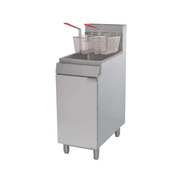
- Gas — high heat, strong recovery, and independent of a big power circuit. The floor-standing gas fryers are the workhorses for a busy takeaway or pub kitchen doing constant volume. Needs a gas connection and proper ventilation.
- Electric — simple to install (just a power point of the right rating), good temperature control, and fine for counter-top and moderate volume. The versatile default where gas isn't available.
- Induction — the most efficient and controllable electric option: heat goes into the oil, not the room, with fast recovery and less waste heat. A premium counter-top choice for a tight or hot kitchen.
Quick sort: constant high-volume frying with gas available → gas floor-standing. Moderate volume or no gas → electric. Efficiency and control in a small footprint → induction.
Counter-top or floor-standing?
- Counter-top — sits on a bench, for cafés, small kitchens and lower volume. Easy to install and move.
- Floor-standing — a full unit with the tank at working height and more capacity, for sustained high-volume service. This is what a busy fish-and-chip shop or pub kitchen runs.
The range — single or twin tank
A twin-tank fryer keeps two oils separate — so you can fry fish in one and chips in the other without flavour crossover, or run one tank and rest the other. If you fry more than one type of food, or want redundancy at peak, twin tank earns its place. Single tank is simpler and cheaper where you only fry one thing or volume is modest. Match the tank capacity to your busiest run — a fryer topped out every service recovers slowly and cooks unevenly.
| Model | Fuel | Format | Tank | Notes |
|---|---|---|---|---|
| GF-24 | Gas (LPG) | Floor-standing | 24 L | Single tank, twin baskets |
| GF-28 | Gas (LPG) | Floor-standing | 28 L | Single tank, twin baskets |
| GF2-20 | Gas (LPG) | Floor-standing, 6-burner | 2 × 20 L | Twin tank, twin basket |
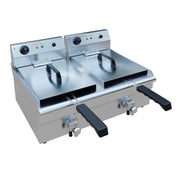
| EF-102V | Electric | Counter-top | 2 × 10 L | Twin tank, drain taps |
| FSEF-14T | Electric | Floor-standing | 2 × 14 L | Twin tank |
| IF-350-8L | Induction 3.5kW | Counter-top | 8 L | Single tank, fast recovery |
| IF-350-16L | Induction 3.5kW | Counter-top | 2 × 8 L | Twin tank, fast recovery |
| IFS-30L | Induction | Floor-standing | 30 L | High volume |
Tap any model for live pricing, full specs and stock.
What to look for
- Recovery time — how fast the oil returns to temperature after a load goes in. It's what separates crisp from greasy at volume; gas and induction recover fastest.
- Drain tap — on the larger tanks, for cleaning and oil changes without ladling. Our twin-tank models include drain taps.
- Removable baskets and tank — for cleaning and oil filtering.
- Thermostat and safety cut-out — accurate temperature control and an over-temperature cut-out are essential on a vat of hot oil.
- Ventilation — deep frying needs extraction; plan the canopy, especially for gas.
Frequently asked questions
Gas or electric deep fryer?
Counter-top or floor-standing?
What's the point of a twin tank?
What size do I need?
Once submitted, we will email you promptly.